An Update on Our Navajo Workforce Services Web-app

In October 2025 we launched our Navajo Workforce Services web-app. It has been a busy year.

There has been an explosion of new LLM releases in Generative-AI. Each release has a significant effect on solutions using them in terms of: establishing a sustainable business model; the ways in which the solution is architected; and, more significantly, the quality and quantity of the information being returned in responses to the prompt engineering (and the corresponding human-in-the-loop experience). While this is great when using AI-enabled tools (such as Claude Code to support software development) it is a nightmare when creating an AI-enabled tool and needing to complete extensive testing to create a robust, reliable and stable web-app solution.

We have been working on the use of Generative-AI in two related areas:

    • A new web-app that supports learners, teachers/faculty, mentors and employers to create and use training/learning digital content that is personalized to the learner so they can acquire the specific knowledge, skills and abilities they need for their career development. This includes development of the material using well established pedagogical methods based on concept maps and reinforced learning. More about this in August (2026) when we hope to make the web-app available for early adopters
    • A revamp of the Workforce Services web-app to make it easier to support, to extend its functionality and to simplify integration with any third-party job board. The original web-app was specific to job seekers and employers of the Navajo Nation*.

The current version of the Navajo Workforce Services (https://navajo-workforce.edtechforlearning.org) web-app is designed to support two user scenarios. The first enables job seekers to search and identify suitable job opportunities and the second enables employers to create clear job descriptions so that job seekers can understand their suitability for those jobs: at present the operational version of the web-app only supports job seekers. These scenarios draw upon three key features: the job seeker provides their resume (as a PDF); the employer makes their job descriptions available through the corresponding job board; Generative-AI is used to identify the Knowledge, Skills and Abilities (KSAs)** required by the job description, attained by the job seeker, and the matching between the job descriptions and the resume.

From the job seeker’s perspective, the user story is very simple (a short video of the workflow is available at (https://edtechforlearning.org/workforce-services-app/):

    1. You login to the web-app (https://navajo-workforce.edtechforlearning.org) using your Google account
    2. Next, use the ‘For job Seekers’ menu link after which various options for providing your job resume are presented. On the first visit you upload a PDF version of your resume (typically 1-2 pages long but the web-app will accept any length document).
    3. To activate the upload you click on the ‘Perform job match’ button. The resume is now uploaded and the web-app uses Generative-AI to inspect the resume and identify the set of Competency Statements (each of which consists of the corresponding set of KSAs)
    4. Once this automated analysis is completed the list of competency statements is presented. The details of the statements can be explored and refined by clicking on the ‘Suggested Changes’ button alongside each statement. This ‘Human-in-the-Loop’ chat process is moderated using Generative-AI and allows the job seeker to confirm/improve the accuracy of the statement
    5. The next step, activated by clicking the “next’ button, is to either compare your competency statements against the set of available job descriptions or to save the statements for later use. The list job descriptions will have been uploaded/updated and analysed previously by the web-app accessing the corresponding job board
    6. The ‘Match Against All Available Jobs’ button is used to start the search against the set of job descriptions available to the web-app. Upon completion of the search the list of those job descriptions with the best match (an algorithm that requires a match correlation of at least 75%) is presented. This list provides access to the full job description and also identifies the competencies that are missing from the job seekers resume.
    7. The final step is to complete the process by leaving the web-app and to receive the list of saved KSAs (these can also be accessed through later uses of the web-app by the job seeker).

Once we have sufficient usage and feedback from job seekers we can improve their user experience and then make available the employers’ capabilities. For employers, the web-app enables them to inspect and amend the analysis of the job descriptions by Generative-AI to confirm/improve the accuracy of the KSAs associated with the job. We will then improve the comparison between the job seeker’s KSAs and those required by the set of available job descriptions to provide detailed skills-gap analysis followed by recommendation of the appropriate available digital learning content. More details on these extended capabilities and the full ‘Achievements Pipeline’ are available in our White Paper (https://edtechforlearning.org/projects-achievement-pipeline/). At a more general scope we will improve support for:

    • Accessibility (both in terms of the user experience of the web-app as a whole and, perhaps more significantly, the interaction with the various chat-bots that provide the human-in-the loop interactions). We will use open standards to enable the appropriate configuration of the web-app user experience
    • The collection of usage data so that we can understand how the web-app is being used and the strengths and weaknesses of Generative-AI for both the creation of the KSAs and the human-in-the-loop chatbots
    • A user to provide feedback on their experience and to suggest new functionality.

If you work with a community that provides job boards and want to make tools available to support use of a job board, or know someone who does, then we would love an introduction.


* This work was supported by a grant from GitLab Foundation (https://www.gitlabfoundation.org) under their AI for Economic Opportunity (https://www.gitlabfoundation.org/our-journey/ai-economic-opportunity-fund-inaugural-grantees) programme and we thank them for support of our work.

** Knowledge is ‘what you know’ in terms of concepts, principles and procedures. Skills are the learned proficiencies developed through the practice of the application of the knowledge. Abilities are the innate capabilities and the capacity acquired through experience to perform a skill.


Also published on the EdTech For Learning LinkedIn page: https://www.linkedin.com/pulse/update-our-navajo-workforce-services-web-app-edtech-for-learning-wp5xe/
Soft Launch of the EdTech For Learning Navajo Workforce Services Web-app

Today we have a soft launch of our Navajo Workforce Services Web-app. Access is through the link: https://navajo-workforce.edtechforlearning.org and then sign-in using Google. This app enables a user to upload their resume (as a PDF file) and to identify the set of jobs on the Navajo Reservation for which they are best suited.

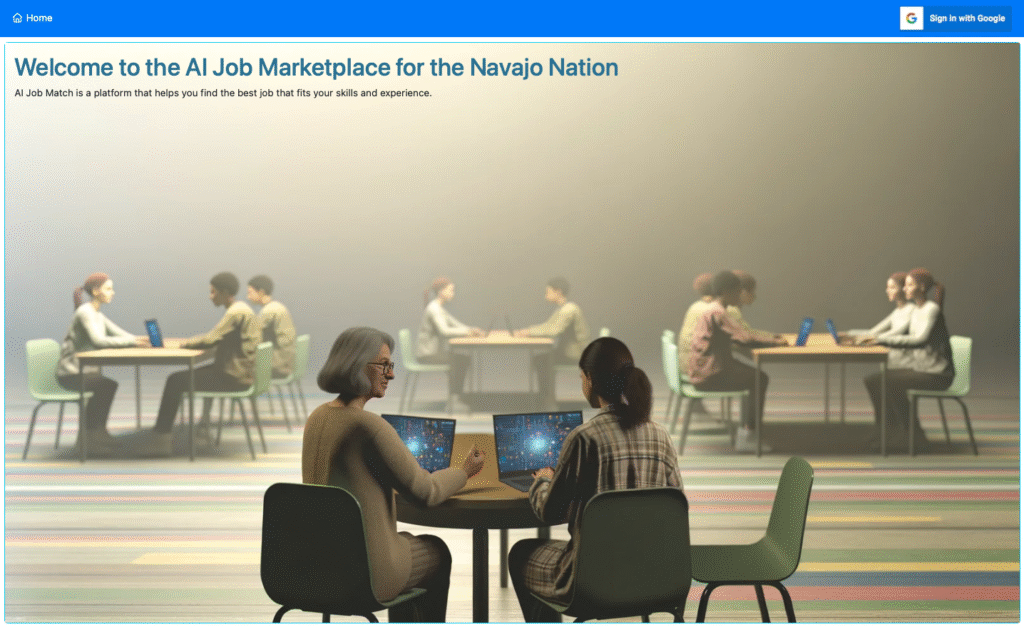
Landing-page for the Navajo Workforce Services Web-app.

Once the resume has been uploaded the web-app uses Generative-AI to identify the associated competencies in terms of the Knowledge, Skills and Abilities (these are then made available to the user so that a more detailed resume can be created). It is these competencies that are used to identify the appropriate set of jobs. The user can amend/extend the list of competencies to make sure that these are an accurate reflection of the user’s competencies.

Please note that the web-app DOES NOT STORE any personal information from the resume (see the web-app’s privacy statement for more information).

For those of a more technical orientation I point out that access to the web-app is through an LTI launch. The 1EdTech Learning Tools Interoperability (LTI) Advantage specification is an open standards-based integration technique. This means that access to the web-app is easy for those systems that are certified LTI Platforms (the web-app is an LTI Tool). Please contact Stephen Vickers (svickers@edtechforlearning.org) if you want to have such an integration with your platform.

We have architected the so that it could be deployed to support other communities i.e. using the relevant job descriptions. The web-app loads in the set of job descriptions from the linked job board. During the acquisition of the set of job descriptions the web-app uses Generative-AI to identify the set of associated competencies (as KSAs).

We thank GitLab Foundation for their support in the development off this web-app (for more information see: https://edtechforlearning.org/workforce-services-app/).


Also published on the EdTech For Learning LinkedIn page: https://www.linkedin.com/pulse/soft-launch-edtech-learning-navajo-workforce-services-ifjge/

The United Nations Sustainable Development Goals and the EdTech for Learning Mission Statement

The United Nations Sustainable Development Goals (SDGs) are a universal call to action to end poverty, protect the planet, and ensure peace and prosperity for all by 2030. Adopted in 2015 by all UN Member States as part of the 2030 Agenda for Sustainable Development, the 17 goals provide a comprehensive framework for addressing the world’s most pressing social, economic, and environmental challenges. The SDGs are interconnected, recognizing that progress in one area often depends on progress in others. For instance, quality education and gender equality contribute to economic growth, while climate action supports sustainable agriculture and water security. Implementation requires collaboration between governments, the private sector, civil society, and individuals. These SDGs (https://sdgs.un.org/goals) are an insightful summary of humanity’s failure for enlightened collaboration or to appreciate and look after our global environment.

From the perspective of EdTech For Learning’s mission statement the most relevant of the UN’s SDGs is number four (4), being “Quality Education” (https://sdgs.un.org/goals/goal4). However both SDGs five (5) and eight (8), “Gender Equality” (https://sdgs.un.org/goals/goal5) and “Decent Work and Economic Growth” (https://sdgs.un.org/goals/goal8) respectively are relevant. The goal of “Quality Education” is expressed as “Ensure inclusive and equitable quality education and promote lifelong learning opportunities for all”. This, Goal 4, focuses on ensuring inclusive and equitable quality education and promoting lifelong learning opportunities for all by 2030. Education is recognized as a fundamental human right and a key driver for achieving sustainable development. It empowers individuals, reduces poverty, promotes gender equality, fosters peace, and drives economic growth. However, millions of people around the world still lack access to quality education due to poverty, conflict, discrimination, and inadequate infrastructure.

Goal 4 comprises ten (10) specific targets that address different dimensions of education. These include universal access to free, equitable, and quality primary and secondary education (Target 4.1), ensuring that all children complete schooling leading to relevant learning outcomes. Early childhood development and pre-primary education (Target 4.2) aim to prepare children for primary education, recognizing that early learning lays the foundation for lifelong development. Technical, vocational and tertiary education (Target 4.3) seeks to ensure equal access for all, including women, persons with disabilities, and marginalized groups, to affordable and quality higher education. Skills for employment, decent jobs, and entrepreneurship (Target 4.4) focus on equipping youth and adults with the competencies needed for the workforce, particularly in a rapidly changing technological world.

Another key aspect of Goal 4 is the emphasis on eliminating gender disparities and ensuring equal access to all levels of education (Target 4.5). This includes addressing barriers faced by girls, persons with disabilities, indigenous peoples, and children in vulnerable situations. Literacy and numeracy (Target 4.6) aim for all youth and a substantial proportion of adults to achieve basic literacy and numeracy skills. Education for sustainable development and global citizenship (Target 4.7) highlights the need to integrate values such as human rights, gender equality, environmental awareness, and cultural diversity into education systems. The remaining targets (4.a–4.c) emphasise the importance of safe, inclusive learning environments, scholarships for developing countries, and the recruitment and training of qualified teachers, recognising that teacher quality is one of the strongest influences on student achievement.

The 2025 progress report on the SDGs is available at https://unstats.un.org/SDGS/REPORT/2025. The findings for “Quality Education (Goal 4) are:

  • Education is vital for sustainable development, yet progress remains off track. While enrollment and completion rates have improved since 2015, with girls outperforming boys in most regions, progress is slowing. Meanwhile, 272 million children and youth remained out of school in 2023.
  • Learning outcomes are declining in many countries. Although literacy has improved modestly, hundreds of millions of people remain illiterate, with women disproportionately affected. Deep inequalities persist due to gender, wealth and geography.
  • To accelerate Goal 4, countries must prioritize inclusive policies and financing that simultaneously address access, learning and equity. This includes scaling up quality early childhood education, enforcing legal guarantees for free and compulsory education, closing digital and infrastructure gaps – especially in LDCs [Least Developed Country] – and expanding lifelong learning opportunities for adults and marginalised populations.

The EdTech for Learning mission statement includes “Access to good quality education is essential for the prosperity and fulfillment of individuals, organizations, countries and the world as a whole. Modern teaching and learning are, increasingly, dependent on access to good quality online content. Not everyone has access to education. The appropriate use of Education Technology (EdTech) can resolve many access and quality problems. Unfortunately, most EdTech is difficult and expensive to deploy.”

A visualisation of our solution thesis is shown in the accompanying diagram.  We want to create open-source solutions that can be adopted and adapted by social entrepreneurs to support teaching and learning in their relevant communities.

A key component of that open-source solution is the creation of an AI-Powered Personal Tutor to support life-long learning and career development. We are building upon our extensive experience in education to create such a solution. More about this in later blogs.


Thanks to ChatGPT for providing various summaries of the SDGs (I have checked that these summaries are factually correct). Any criticism of humanity’s progress is all my own work.

Also published on the EdTech For Learning LinkedIn page: https://www.linkedin.com/pulse/united-nations-sustainable-development-goals-edtech-dapve/

Wrapping Up Our GitLab Foundation AI for Economic Opportunity Grant

We are coming to the end of our GitLab Foundation funded project “Bridging skills and Opportunities for Navajo People with AI-enhanced Employment Matching”. We have entered into our initial user evaluations phase and this will be completed within the next 8 weeks.
 
We have just relaunched our website (edtechforlearning.org) and it now includes a lot of support information about our Navajo project. If you want to find out more about our Navajo project then use the link: Navajo Workforce Services App. In fact, you can try out our new proof-of-concept Workforce App at: edtechforlearning.app.

GitLab Foundation Announces Inaugural AI for Economic Opportunity Fund Grantee Cohort

Gitlab grantee

So, we have very exciting news. Our first application for funding has been successful and we have secured funding from GitLab Foundation. The title of our project is: “Bridging skills and Opportunities for Navajo People with AI-enhanced Employment Matching“.

The summary of the project is:

Our objective is to place 200-500 Navajos into net-new ‘Thriving Wage Jobs’ or better paying jobs in 2024 and for this number to increase annually as the range of jobs with validated competency maps and the number of Navajo job seekers complete guided upskilling plans increases. Traditional methods for creating job competency maps and job-seeker profiles are labor-intensive. Usage of AI and large job-related data stores will accelerate the gathering of data about both jobs and job seekers. We will create matching reports to show job seekers the jobs for which they are best prepared and provide them with pathways in learning aligned with their missing competencies. We will scale and localize job candidate data with novel, AI-driven “interview” tools. We anticipate a factor of 10 increase (cf. the current manual process) in the number of job maps and job seeker profiles created in the Navajo context and beyond.

Introduction

We are a new non-profit, called EdTech for Learning, established to champion access to, and the usage of, education technologies (EdTech) to improve teaching and learning.  EdTech for Learning will create a range of EdTech solutions that are low cost, easy to deploy, manage and use.

These systems will be built upon open source technology and use EdTech interoperability standards to enable the establishment of EdTech Ecosystems.

More importantly, the emphasis will be on identifying, enabling and supporting local social entrepreneurs who will improve teaching and learning in their communities around the World through the use of these new EdTech Ecosystem solutions.